
"Oil marketing companies are to take decision depending on cost of their imports. It is market related as per as oil market companies are concerned on petrol," Mukherjee told reporters.

ITC, State Bank of India, HCL Technologies and IndusInd Bank were the other big laggards. NTPC, UltraTech Cement, HDFC Bank and Mahindra & Mahindra were among the gainers.

The decision came following the intervention of Civil Aviation Minister Vayalar Ravi who met Petroleum Minister S Jaipal Reddy to sort out the issue.

Investors booked profits in late trades ahead of the assembly election results due on Sunday.
The oil ministry is in fact of the view that the government should bear the entire burden of the revenue losses incurred by the oil marketing companies, after the increase in prices is effected.

Hiring trends in India's white-collar job market dipped marginally by 1.4 per cent in March compared to the same month last year, driven by a decline in recruitment in the retail, oil & gas, and education sectors, a report said on Wednesday.

India may have to lean more on West Asian nations for supplies of liquefied petroleum gas (LPG), a cooking fuel, in the coming years after Indian state-run refiners drew up big plans to diversify into producing more profitable petrochemicals. This shift leads to reduced LPG output, Indian refining executives said. The mantra for state-run oil companies, from Indian Oil Corporation (IndianOil) to liquefied natural gas (LNG) importer Petronet LNG, which are looking to diversify their businesses from lower-margin fuels, has been value-added petrochemicals.

In trade negotiations, as in chess, sometimes you need to accept a temporary disadvantage to secure a better long-term position, points out Sonal Varma, chief economist (India and Asia ex-Japan) at Nomura.

RBI feels that oil firms seeking a single quote for their dollar requirement, instead of present practice of floating enquiring with several pubilc and private sector banks, would help check volatility and arrest the free-fall of the rupee.

Movement in the stock market this week will largely be driven by global trends, macroeconomic data announcements and trading activity of foreign investors, analysts said. Equity benchmark indices, which are on a dream run for the past several days, will also track trading in global oil benchmark Brent crude and movement of rupee against the US dollar. "The next FOMC (Federal Open Market Committee) meeting is scheduled for mid-September, but before that, the market will be closely watching upcoming US economic data.

Reliance Industries (RIL), India's largest conglomerate, is set to pivot into a deeptech and advanced manufacturing enterprise, chairman and managing director (CMD) Mukesh Ambani said. "In artificial intelligence, our purpose is clear: to address complex societal challenges and create wealth for the nation and its people.

Oil marketing cos rightly passed on the burden to buyers.
Reliance Industries is seeking about Rs 400 crore (Rs 4 billion) from state-owned oil retailers in unrealised amount on liquefied petroleum gas and kerosene, it sells to them.
Investor wealth eroded by Rs 4.46 lakh crore in a single day on Friday with the benchmark BSE Sensex tanking more than 1 per cent in line with global stocks rout. The 30-share BSE Sensex plunged 885.60 points or 1.08 per cent to close at 80,981.95 with 25 of its components declining and five ending with gains. During the day, it nosedived 998.64 points or 1.21 per cent to hit an intra-day low of 80,868.91.

Global trends, macroeconomic data announcements and the start of the earnings season would be the major drivers for the equity markets in a holiday-shortened week, analysts said. Equity markets will remain closed on Thursday for Eid-Ul-Fitr. Trading activity of foreign investors, rupee-dollar trends and crude oil prices would also guide trends in markets.
Public sector oil companies lost Rs 9800 crore (Rs 98 billion) in the first six months of 2004-05 fiscal for selling petroleum products below the import cost, Petroleum Minister Mani Shankar Aiyar said on Tuesday.

Relief seen from easing global crude oil prices, phased diesel decontrol and capping of LPG cylinders.

ICICI Securities has estimated that the recent hike in fuel prices will result in a reduction of about Rs 26,000 crore (Rs 260 billion), or 40 per cent, in the subsidy burden of the oil marketing companies due to higher realisation.
Under-recoveries by state-owned oil marketing companies are set to hit a new record in June with the under-realisation on the sale of diesel, the largest selling fuel and also the most politically sensitive, almost matching the subsidised selling price.

For BCPL's branded petrol, Speed, the price differential with regular petrol is now between Rs 2.74 and Rs 3.75 per litre.
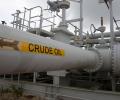
The basket of crude oil that India buys has hit a decade high of $121 per barrel, but retail selling prices of petrol and diesel continue to remain frozen. The Indian basket on June 9 touched $121.28, matching levels seen in February/March 2012, according to data available from the oil ministry's Petroleum Planning and Analysis Cell (PPAC). As per the PPAC, the Indian basket of crude oil averaged $111.86 per barrel between February 25 and March 29 - the immediate period after Russia's invasion of Ukraine sent oil on fire.

The Indian services growth broadly steadied in May and was underpinned by healthy demand conditions, new client wins and greater staffing capacity, a monthly report said on Wednesday. The seasonally adjusted HSBC India Services PMI Business Activity Index was at 58.8 in May, marginally up from April's 58.7 and signalled another sharp rate of expansion.
Besides, it owes an interest of Rs 423.43 crore (Rs 4.23 billion) to IOC, Rs 92.73 crore (Rs 927.3 million) to BPCL and Rs 66.17 crore (Rs 661.7 million) to HPCL.
State-owned oil marketing companies on Wednesday stopped jet fuel supplies to Air India in the four metros after cheques from the national carrier towards payment for fuel bounced, raising fears that the airline's flight schedules might be badly disrupted.
Markets consolidated in late trades to end lower as investors booked profits after the benchmark indices ended at their all-time closing highs yesterday.

The upstream oil and gas (O&G) sector has delivered a stellar performance in the stock market in the recent past. The O&G sector is dominated by PSUs and despite the imposition of a windfall tax, profitability has been impressive. Oil India Limited (OIL) is particularly favoured by investors.

Geopolitical events, macroeconomic data and quarterly earnings of corporates would guide the stock market in a holiday-shortened week ahead, analysts said. Stock markets will remain closed on Wednesday for Ram Navami. "This week promises to be crucial for the market as fresh worries about a potential conflict between Iran and Israel emerge.

Those losses, or 'under-recoveries', are of course eventually covered partly by the central government, and are the most potent contributor to India's problems with its fiscal deficit.
Petroleum Minister Murli Deora will meet Finance Minister P Chidambaram next week to discuss a package to bail out public sector oil firms that have been suffering huge losses on account of selling fuel on discounted prices.

'He has been one of the clearest thinkers in the history of business.'

Equity markets will take cues from global trends and trading activity of foreign investors, while in the latter part of the week the first quarter earnings from IT majors TCS and HCL Technologies would guide investor sentiments, analysts said. Markets may consolidate after the record rally last week, experts added. "On the domestic front, the Q1 earnings season begins this week. Key companies such as TCS and HCL Technologies will release their earnings on July 11 and 12, 2024, respectively.
